How to Stack and Store Firewood Properly
Learn the right way to stack, store, and protect your firewood. Covers location, ground clearance, covering, pest prevention, and how much indoor wood to keep.
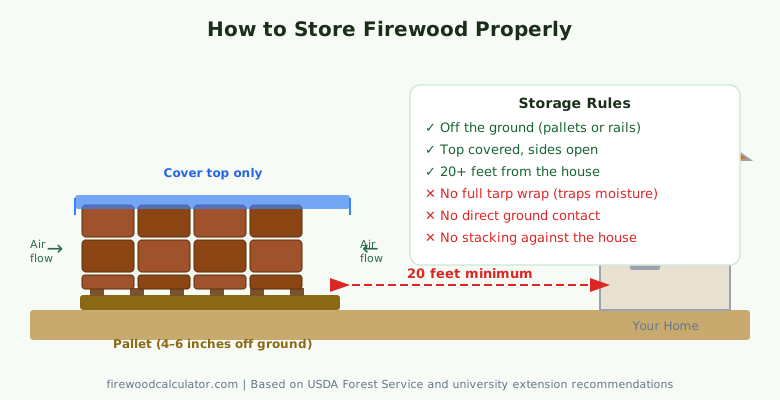
Quick Answer: Stack firewood off the ground, bark-side up, in a single row with open sides for airflow. Cover only the top — never wrap the entire pile in a tarp. Keep stacks at least 20 feet from your house to reduce pest risk, and properly stored hardwood will season in 6–12 months.
How you store firewood affects how quickly it dries, how long it lasts, and whether you're inviting pests into your yard (or worse, your house). Most problems homeowners have with soggy, moldy, or insect-infested wood trace back to a few storage mistakes that are easy to fix.
The Non-Negotiable Rules
Before anything else, get these four things right:
- Off the ground: Wood on bare dirt wicks moisture from the soil and rots. No exceptions.
- Covered on top, open on the sides: Rain hits the top; airflow dries the sides. Cover one without blocking the other.
- 20 feet from the house: Termites, carpenter ants, and mice live in woodpiles. Keep them away from your foundation.
- Split before stacking: Whole rounds season far more slowly than split pieces; stacking rounds tight creates moisture traps.
Get those four right and everything else is optimization.
Choosing a Storage Location
The ideal location is:
- On the south or west side of your property, which gets more sun and wind
- Away from trees and dense vegetation that shade the stack and drop debris on it
- Within reasonable carrying distance of your door — you'll be making this trip daily in January
- On level, well-drained ground
A location that gets direct afternoon sun can cut drying time by weeks. Shade keeps wood damp longer and encourages mold and fungal growth. If your only available space is shaded, compensate by loosening the stack more than usual and ensuring excellent ground clearance.
Before you decide how much firewood to store, use our firewood calculator to figure out your seasonal cord count. No sense building a 4-cord storage setup if you only need 2 cords.
Getting Off the Ground: Your Options
Pallets: Free or cheap from hardware stores, grocery stores, or landscaping suppliers. A standard pallet measures 40×48 inches and comfortably supports 1/3 cord. Stack two pallets end-to-end for a half-cord base; use three or four for a full cord. They raise wood 4–6 inches off the ground, provide excellent airflow underneath, and are free to replace when they rot after a few years.
Pressure-treated 2×4 rails: Two parallel rails placed 8 feet apart provide a clean base for a full-cord stack. Use pressure-treated lumber (rated for ground contact) to resist rot. This is a permanent, low-cost solution that works well on gravel or packed dirt.
Commercial firewood racks: Metal tube-steel racks work well for 1–2 face cords. They're easy to move but can tip in wind if not anchored. Most hold a half-cord or less. Good for beside-the-door convenience storage, less practical for main seasonal storage.
Poured concrete slab: If you're serious about firewood storage long-term, a small concrete slab (8×8 feet for a cord) eliminates the ground moisture problem entirely. Pair with 2×4 rails on the slab for even better airflow.
How to Stack a Cord
A full cord is 4 feet high, 4 feet deep, and 8 feet wide — or any combination that totals 128 cubic feet. For practical stacking, most people do two parallel rows: each 4 feet high, 4 feet deep, 8 feet long, split down the middle with a 6-inch gap.
Technique:
- Start with the straightest, flattest pieces on the bottom row
- Alternate the direction of bark on each layer — bark up one row, bark down the next — to prevent locking pieces together
- Leave 1/2 inch gaps between pieces in each row for airflow
- Place the split (grain-exposed) face outward for faster drying
- Keep rows as close to level as possible — a leaning stack is an unstable stack
The crib ends method: To make freestanding stacks without end supports, build "crib" corners — alternating layers at 90° angles, like a log cabin corner. This is slower to build but produces a very stable stack that doesn't need posts or stakes.
The lean-to method: Simpler and faster — lean pieces against a fence or wall in a teepee arrangement. Not ideal for drying (less airflow) but works for short-term storage or kindling.
What to Use as a Cover
The most important rule: cover the top only, not the sides.
Tarp: Cut to size or folded so it covers the top 2–3 rows with 12 inches of overhang on each side. Use bungee cords or rocks on the corners to keep it from blowing off. Replace tarps every 2–3 years as UV exposure degrades them.
Metal roofing panels: A 2-foot strip of corrugated metal bent over the top of the stack provides permanent, effective protection. It sheds rain better than a tarp and lasts indefinitely. Requires drilling two holes at each end for stakes or rope.
Purpose-built firewood covers: Canvas or polyethylene covers made specifically for cord wood work well but often cost $30–80. They're no better than a properly fitted tarp at a fraction of the cost.
Firewood shed: Three walls (back and two sides) plus a roof with an open front is the gold standard. Wood is protected from all weather, fully ventilated from the front, and stays organized. A 6×8-foot shed holds about 1.5 cords. If you heat primarily with wood, this investment pays for itself in preserved wood quality within a few seasons.
Pest Control Around Your Woodpile
Termites, carpenter ants, wood-boring beetles, mice, and black widow spiders all live happily in firewood stacks. The key is keeping them in the yard, not the house.
Keep the pile 20 feet from the foundation — this is the most important rule. Studies by the University of Florida Extension found that wood stored within 3 feet of a structure was dramatically more likely to become a pest access point than wood stored more than 20 feet away.
Inspect before bringing wood inside: Shake each piece over the porch before carrying it in. Look for sawdust (beetle larvae sign), hollow sounds when tapped, or movement. You don't need to be paranoid — a quick inspection takes 5 seconds per piece.
Don't treat with insecticide: Burning treated wood releases toxic compounds. If you have a persistent ant or beetle problem, address it with traps and physical barriers, not chemicals on the wood itself.
Only bring in what you'll burn in 1–2 days: Keep your indoor wood rack stocked with just enough for the next 48 hours. This limits any pest hitchhikers to a short window and keeps the house tidier.
Indoor Wood Storage
Most homes with a fireplace or wood stove benefit from a small indoor log holder or rack near the hearth. Typical capacity is 1/4 to 1/2 face cord — enough for 2–3 days of heating.
Location tips:
- Keep at least 36 inches from the stove or fireplace opening
- Place on a non-flammable surface (tile, brick, or stone)
- Don't store against drywall — condensation from wood can cause moisture problems over time
For overnight burns, load the stove from the outdoor pile directly rather than pre-staging large amounts indoors. Carrying a few pieces on demand is less convenient but reduces the amount of yard dirt and insects coming into the house.
How Long Firewood Lasts
Properly stored, dry firewood lasts 3–5 years without significant quality degradation. After 5 years, some checking (splitting) and surface weathering occur, but interior quality is usually preserved. Wood that stays dry doesn't rot.
The enemy is not time — it's moisture. Wood that stays damp for even one season can develop mold, surface fungi, and begin to soften. Mold on the bark is mostly cosmetic and burns off. Soft, punky wood that crumbles when struck is genuinely degraded and burns poorly.
If you've purchased more wood than you'll use this season — easily done if your estimate was off — see our firewood needs calculator to calibrate your order size for next year. Well-stored extra wood isn't waste; it's head start on next winter.