Firewood BTU Chart: Heat Output by Wood Species
Complete firewood BTU chart comparing heat output per cord for 20+ wood species. Use this data to choose the right firewood and calculate exactly how many cords you need.
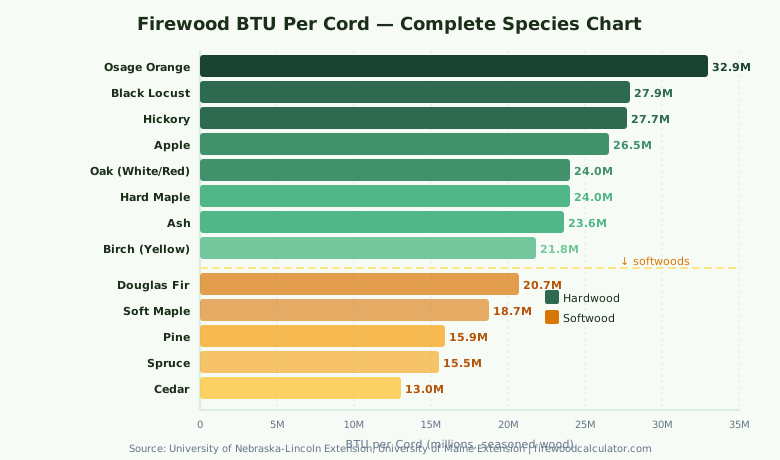
Quick Answer: BTU measures firewood's heat energy per cord. Hickory leads at 27.7 million BTU/cord; oak, maple, and ash follow at 24–26M BTU/cord. Softwoods like pine average 14–17M BTU/cord. Higher BTU means fewer cords needed per heating season — use the firewood calculator to convert BTU into cord counts for your home.
BTU — British Thermal Unit — is the most useful number in firewood. One BTU is the energy needed to raise one pound of water by one degree Fahrenheit. A cord of oak contains about 24 million of them. Knowing this number for the species you're burning lets you estimate your seasonal cord needs accurately, compare species by value, and understand exactly what you're getting when you buy firewood.
This chart covers the most common North American firewood species. Data is sourced from the University of Nebraska-Lincoln Extension and the University of Maine Cooperative Extension — the two most widely cited academic sources for firewood BTU ratings.
BTU Per Cord: Complete Reference Chart
All values are for seasoned wood (less than 20% moisture content). Green wood produces 15–25% less usable heat.
Exceptional Heat (25+ million BTU/cord):
- Osage orange (hedge apple): 32.9 million BTU — the densest common firewood in North America; extremely difficult to split
- Black locust: 27.9 million BTU — dense, splits easily when fresh, seasons quickly for a hardwood
- Hickory (all varieties): 27.7 million BTU — heaviest common firewood (~4,327 lbs/cord); excellent coals
- Ironwood (hornbeam): 27.3 million BTU — very dense, found in eastern woodlands
High Heat (22–25 million BTU/cord):
- Apple: 26.5 million BTU — excellent coals, prized for cooking and smoking; usually not sold commercially
- Mulberry: 25.8 million BTU — burns hot, seasons reasonably fast
- Black cherry: 26.0 million BTU — pleasant aroma, good coals, 12-month seasoning
- White oak: 24.0 million BTU — the standard reference species; excellent in every category
- Red oak: 24.0 million BTU — identical to white oak in practice; more widely available in some regions
- Sugar maple (hard maple): 24.0 million BTU — matches oak, seasons in 9–12 months
- Beech: 24.0 million BTU — similar to maple; less common but excellent for heating
- Honey locust: 26.7 million BTU — dense hardwood; thorny and difficult to handle
Good Heat (20–22 million BTU/cord):
- Yellow birch: 21.8 million BTU — best of the birch species for heating
- White ash: 23.6 million BTU — easy to split, good BTU, unfortunately devastated by the emerald ash borer
- Elm: 20.0 million BTU — difficult to split (interlocking grain); reasonable heat once processed
- Birch (white/paper): 20.8 million BTU — lights easily, seasons fast, moderate burn time
- Tamarack (larch): 20.8 million BTU — one of the few softwood species with hardwood-level BTU
Moderate Heat (16–20 million BTU/cord):
- Black walnut: 22.2 million BTU — rarely sold as firewood due to value of the wood for other uses
- Silver maple (soft maple): 18.7 million BTU — significantly less than hard maple; ask your supplier which type
- Red maple: 18.7 million BTU — common substitute when hard maple is unavailable
- Sycamore: 19.5 million BTU — burns adequately; difficult to split due to interlocking grain
- Cherry: 20.4 million BTU — aromatic, nice for supplemental heating or indoor fireplaces
- Douglas fir (Pacific Northwest): 20.7 million BTU — the best of the softwoods; popular in the western US
Lower Heat (under 16 million BTU/cord):
- Pine (various): 15.9 million BTU — wide range by variety; high resin content
- Spruce: 15.5 million BTU — lighter and faster-burning than pine
- Cottonwood: 13.5 million BTU — one of the lowest-density hardwoods; burns poorly for heating
- Cedar (western red): 13.0 million BTU — aromatic, excellent kindling; poor primary fuel
- Alder: 17.5 million BTU — popular in the Pacific Northwest, moderate output
How to Use These Numbers
Step 1: Identify the species you're buying or have available.
Step 2: Use our firewood calculator to estimate your seasonal cord needs — the BTU data above is built into the calculation for all common species.
Step 3: Calculate cost per million BTU to compare species value:
*Cost per million BTU = Price per cord ÷ (BTU per cord × appliance efficiency)*
Example: Oak at $300/cord, EPA stove (75%):
$300 ÷ (24,000,000 × 0.75) = $300 ÷ 18,000,000 = $16.67 per million BTU
Example: Pine at $180/cord, same stove:
$180 ÷ (15,900,000 × 0.75) = $180 ÷ 11,925,000 = $15.09 per million BTU
At these prices, pine is actually slightly cheaper per unit of heat — but oak produces better coals, creates less creosote, and requires fewer stove loads. The right choice depends on what you value most. See our hardwood vs. softwood comparison for a full breakdown.
How Moisture Affects BTU Output
The numbers above assume properly seasoned wood at less than 20% moisture content. Green wood performs significantly worse:
- Green wood (40–50% moisture): 15–25% less usable heat per cord
- Partially seasoned (25–35% moisture): 10–15% reduction
- Properly seasoned (below 20%): Full BTU value
- Kiln-dried (below 15%): Essentially full BTU value, slightly faster ignition
Always verify moisture content with a pin-type moisture meter ($15–25) before accepting delivery or burning. Press the pins into a freshly split face for an accurate reading.
Regional Availability
Not every species is available everywhere. Here's a rough guide:
Northeast & Upper Midwest: Oak, maple, birch, ash, beech, hickory (southern half), cherry
Southeast: Oak, hickory, black walnut, osage orange, locust, pine
Pacific Northwest: Douglas fir, alder, big-leaf maple, madrone (one of the densest western species at 30.9 million BTU/cord)
Rocky Mountain region: Pinyon pine (actually decent — 27.1 million BTU/cord due to high resin), juniper, aspen
Local availability matters as much as species rankings. The best firewood is the densest, driest hardwood available in your area at a reasonable price.
Comparing Firewood to Other Fuels
For context, here's where firewood BTU stands against common alternatives:
- 1 cord of oak = 24 million BTU (seasoned, before efficiency losses)
- 1 gallon of heating oil = 138,500 BTU
- 1 therm of natural gas = 100,000 BTU
- 1 gallon of propane = 91,500 BTU
At 75% stove efficiency, a cord of oak delivers 18 million usable BTU — equivalent to about 130 gallons of heating oil or 180 therms of natural gas. Whether that's a better deal depends entirely on local fuel prices. Our cord needs estimator includes an estimated cost output so you can do this comparison directly.