Firewood vs Gas vs Electric: 2025 Heating Cost Comparison
Compare heating costs for firewood, natural gas, propane, heating oil, and electric heat in 2025. Real numbers showing when wood heat saves money — and when it doesn't.
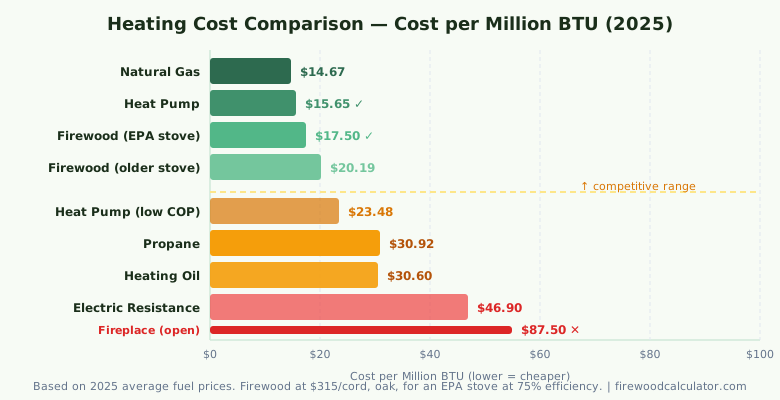
Quick Answer: In a modern EPA wood stove, firewood costs roughly $17–$20 per million BTU — comparable to natural gas and far cheaper than propane ($31/MMBTU), heating oil ($31/MMBTU), or electric resistance ($47/MMBTU). Open fireplaces are the most expensive heating method at around $87/MMBTU due to their 10–15% efficiency rating.
Whether firewood is cheaper than your alternative depends entirely on three numbers: local firewood prices, local utility rates, and your heating appliance's efficiency. At a national average level, firewood in an EPA stove competes very well against propane, heating oil, and electric resistance heat — and roughly matches natural gas. But the gap narrows or reverses quickly with inefficient appliances or poor wood quality.
Here's the honest math for 2025.
The Common Framework: Cost Per Million BTU
To compare fuels on equal footing, we convert everything to cost per million BTU delivered (after efficiency losses):
Formula:
Cost per million BTU = (Price per unit × 1,000,000) ÷ (BTU per unit × appliance efficiency)
This accounts for both the raw energy content and how efficiently your appliance converts it to room heat.
2025 Fuel Price Reference Points
These are approximate national averages for spring 2025:
- Firewood (seasoned oak): $280–$350 per cord
- Natural gas: $1.25–$1.45 per therm
- Propane: $2.40–$2.80 per gallon
- Heating oil (No. 2): $3.20–$3.80 per gallon
- Electricity: $0.14–$0.18 per kWh
Regional variation is significant — natural gas in the Southeast runs well under $1/therm; propane in rural Northeast markets can exceed $3.50/gallon in winter.
Cost Per Million BTU: Full Comparison
At mid-range 2025 prices, with realistic appliance efficiencies:
| Fuel | Price | Efficiency | Cost per million BTU |
|---|---|---|---|
| Firewood (oak, EPA stove) | $315/cord | 75% | $17.50 |
| Firewood (oak, older stove) | $315/cord | 65% | $20.19 |
| Firewood (oak, open fireplace) | $315/cord | 15% | $87.50 |
| Natural gas | $1.35/therm | 92% | $14.67 |
| Heat pump (COP 3.0) | $0.16/kWh | 300% | $15.65 |
| Heat pump (COP 2.0) | $0.16/kWh | 200% | $23.48 |
| Propane | $2.60/gallon | 92% | $30.92 |
| Heating oil | $3.50/gallon | 85% | $30.60 |
| Electric resistance | $0.16/kWh | 100% | $46.90 |
Key takeaways:
- Firewood in a modern EPA stove ($17.50/MMBTU) competes closely with natural gas and heat pumps
- Firewood in an open fireplace ($87.50/MMBTU) is the most expensive option listed — by far
- Propane and heating oil are consistently expensive regardless of efficiency improvements
- Electric resistance is always expensive; heat pumps change the economics significantly
When Firewood Wins Outright
Firewood beats natural gas in several real-world scenarios:
Rural areas without pipeline access: If you can't get natural gas and your option is propane, firewood at $300/cord in an EPA stove is typically $10–$15 cheaper per million BTU than propane.
Areas with high electricity prices: In states where electricity costs $0.20+/kWh (California, Hawaii, New England), electric resistance heating exceeds $58/MMBTU — firewood wins decisively.
When you have free or low-cost wood: Cutting your own wood, buying from a farmer clearing land, or buying green in bulk and seasoning yourself can bring your cost per cord down to $50–$150. At $100/cord, firewood delivers heat at roughly $5.56/MMBTU — cheaper than anything else on this list.
Cold climate, long season: A 7-month heating season in Minnesota or Maine amplifies any cost advantage. The savings per MMBTU multiply by every BTU you use.
When Firewood Doesn't Save Money
Natural gas in low-cost markets: In the Southeast and parts of the Midwest, natural gas at $0.80–$1.00/therm delivers heat at $10–12/MMBTU — below firewood in most scenarios.
Efficient heat pumps in mild climates: A heat pump with a COP of 3.5 (high-efficiency unit in mild weather) delivers heat at roughly $13/MMBTU at $0.16/kWh electricity — cheaper than firewood.
Open fireplace users: If you currently heat with an open fireplace, firewood is not economical. You're using wood as entertainment, not fuel. A fireplace insert would change the math dramatically.
Accounting for your own labor: Cutting, splitting, stacking, hauling, and loading a wood stove is real work. If you value your time at $25/hour and processing your own wood takes 20 hours per cord, that's $500 of labor on top of the wood cost. Free wood from your property isn't free if your time has value.
A Practical Annual Cost Estimate
For a 1,500 sq ft home with average insulation, 5-month heating season, using oak firewood in an EPA stove:
- Run the estimate in our firewood calculator: approximately 1.9 cords
- Add 15% buffer: 2.2 cords
- At $315/cord: $693 in wood costs
- At 24 million BTU/cord, 75% efficiency: 16.5 million usable BTU per cord
- Total heat delivered: 36.3 million BTU for the season
Compare to natural gas: 36.3 million BTU ÷ 92% efficiency = 39.5 million BTU raw ÷ 100,000 BTU/therm = 395 therms. At $1.35/therm: $533.
At these prices, natural gas is roughly $160/season cheaper. However, add firewood's non-energy benefits (independence from utility pricing, preparedness for outages, ambiance), and many households find the tradeoff acceptable or even preferable.
Firewood as Energy Independence
One aspect the BTU-per-dollar comparison doesn't capture: a woodpile is stored energy you control. Natural gas prices spiked 60–80% during the 2022–2023 winter in many US markets. Propane prices can double during cold snaps. Once you have firewood stacked, your heating cost is locked in.
For families in rural areas, older homes, or regions with unreliable grid power, firewood isn't just a fuel — it's a backup system. That has value beyond the per-BTU price.
How to Make Your Wood Heat More Economical
- Upgrade your appliance: The single biggest lever. Moving from 15% to 75% efficiency cuts your wood consumption by 80%. See our fireplace vs wood stove comparison.
- Use the right species: Cheap per-cord doesn't mean cheap per-BTU. Know what species you're buying and compare value accurately.
- Buy ahead in spring: Save 15–30% versus October prices.
- Improve insulation: A well-insulated home needs less heat regardless of fuel type. Every dollar spent on insulation reduces your firewood (and gas and electric) bills.
- Calculate precisely: Know your actual cord need before buying. Use the firewood needs estimator to get a number you can plan around.