10 Tips for Buying Firewood Without Getting Ripped Off
Avoid common firewood buying mistakes. Learn how to verify cord measurements, check wood quality, find reputable suppliers, and get the best price on seasoned firewood.
Quick Answer: Before buying firewood, calculate how many cords you need, verify cord dimensions (128 cubic feet stacked), ask for the wood species, and check moisture content with a meter (target under 20%). Get 2–3 local quotes, and pay only after the wood is delivered and stacked so you can confirm the amount.
The firewood market has less consumer protection and less price transparency than almost any other heating fuel. You're often buying from someone with a truck and a chainsaw, with no receipt, no measurement verification, and no recourse if you get shorted. But with a few basic checks, you can buy confidently and get fair value every time.
Here's what experienced wood burners actually do.
Tip 1: Calculate Your Needs Before You Call Anyone
Know how many cords you need before you start getting quotes. Sellers will tell you how much you need — and they have an obvious incentive to overestimate. Use our firewood calculator to generate an accurate estimate based on your home size, wood type, and heating season.
With a number in hand, you can compare quotes on equal terms and push back if someone tries to upsell you.
Tip 2: Always Ask "Full Cord or Face Cord?"
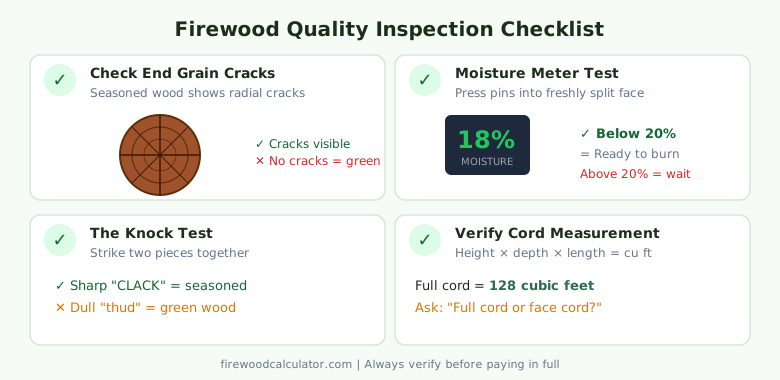
Never assume. The words "cord," "face cord," "rick," and "load" mean different things to different sellers. A full cord is 128 cubic feet (4×4×8 feet stacked). A face cord is roughly 42 cubic feet — one-third of a cord.
When you get a quote, ask: "Is that price for a full cord of 128 cubic feet, stacked?" Any legitimate seller will confirm without hesitation. Sellers who hedge or seem confused about their own measurement should be a red flag.
For a full explanation of cord measurements, see our guide to firewood cord sizes.
Tip 3: Request a Moisture Reading
Dry wood burns efficiently. Wet wood wastes energy and produces creosote. The difference in usable heat between 20% moisture and 40% moisture wood can exceed 25% per cord — which means you'd need to buy 25% more wood to achieve the same heating effect.
Any reputable supplier should have a moisture meter and be willing to take a reading on a freshly split piece in front of you. Target below 20% for ready-to-burn wood. If the supplier doesn't own a moisture meter or refuses to test, that tells you something.
Tip 4: Check the End Grain for Cracks
Seasoned firewood develops radial cracks (like spokes on a wheel) at the cut ends. These form as wood dries and the outer layers shrink faster than the core. The presence of radial end-grain cracks is one of the most reliable visual indicators that wood has been seasoned at least 6–9 months.
Green wood has clean, solid end grain with no or minimal cracking. The cut ends may also look slightly wet or show a blue-gray fungal tint.
Tip 5: Do the Knock Test
Pick up two pieces of firewood and knock them together firmly. Well-seasoned wood produces a sharp, resonant "clack" — almost a ring. Green wood produces a dull thud.
This isn't foolproof, but it takes 2 seconds and gives you a quick sense of the moisture level before you commit to buying.
Tip 6: Buy by Species, Not by "Mixed Wood"
"Mixed wood" or "mixed hardwood" is often a grab-bag of whatever the seller has — sometimes excellent, sometimes mostly low-BTU species. The heat output difference between hickory (27.7M BTU/cord) and cottonwood (13.5M BTU/cord) is enormous. Buying "mixed" without knowing the mix is like buying a bag of mystery groceries.
Ask what species are in the mix. If the seller can't tell you, that's concerning. If they can, look up the BTU output in our firewood BTU chart and decide whether the price reflects the species value.
Tip 7: Compare Price Per Million BTU, Not Price Per Cord
Different species have different heat output per cord. Oak at $300/cord and pine at $180/cord aren't directly comparable on price alone. The right comparison is cost per million BTU of usable heat.
Quick calculation for an EPA stove (75% efficiency):
- Oak: $300 ÷ (24M × 0.75) = $16.67/million BTU
- Pine: $180 ÷ (15.9M × 0.75) = $15.09/million BTU
Pine is slightly cheaper per unit of heat at these prices — but oak burns longer, coals better, and creates less creosote. Understand what you're actually comparing.
Tip 8: Get the Price in Writing
A text message confirming the amount, species, cord measurement, and total price is enough. Professional suppliers will invoice you. Either way, having something written prevents disputes about what was agreed.
Tip 9: Measure the Delivery Yourself
When wood is delivered, measure it. This doesn't have to be confrontational — just do it. Take a tape measure, check height × depth × length, and calculate the cubic footage. If you ordered a full cord (128 cubic feet) and you received something less, address it immediately before the seller leaves.
If wood is delivered loose (thrown off the truck), stack it and measure before paying the balance. Some suppliers deliver a full cord thrown and let you verify after stacking. That's a reasonable arrangement as long as you don't pay in full until you've confirmed the measurement.
Tip 10: Buy in Spring, Not Fall
This is possibly the most valuable tip on this list. Firewood prices are 15–30% lower in late spring than in fall. Availability is better. Sellers are more willing to negotiate. And the wood you buy in May has all summer to season, arriving at peak moisture levels in time for November.
October firewood buying is reactive and expensive. The best-prepared wood burners order their next winter's supply in spring, stack it immediately, and forget about it until the leaves start falling.
Red Flags When Buying Firewood
Watch out for:
- Price that seems too good: Under $150/cord for delivered, seasoned hardwood is almost certainly green, short-measured, or softwood
- Refuses to state cord measurement: All wood sales should be in measurable units
- Won't take a moisture reading: Either they don't care or the wood is wet
- Delivers at night: Hard to verify what you're getting in the dark
- "Best deal you'll find" pressure: Quality suppliers don't need to pressure you
- Cash only, no receipt: Not illegal, but limits your recourse if there's a problem
- Wood delivered as a pile, not stacked: Make sure you have a measurement agreement before accepting delivery
Finding Good Suppliers
Local Facebook Marketplace and Craigslist: Often the best prices, but requires more verification. Established sellers with reviews are preferable.
Local heating supply stores: May be more expensive but are accountable and usually reliable.
Tree services: If you can arrange to buy from a tree service that's already clearing lots, prices can be excellent. Wood may be green and need seasoning.
Neighbors and word of mouth: Recommendations from people who've used a supplier before are gold.
Once you find a reliable supplier, stick with them. A good firewood relationship — where they know your species preferences, can call when they have premium loads available, and will make delivery adjustments — is worth preserving.