How Many Cords of Firewood Do I Need?
Find out exactly how many cords of firewood you need for winter. Estimates by home size, wood type, heating season length, and appliance efficiency.
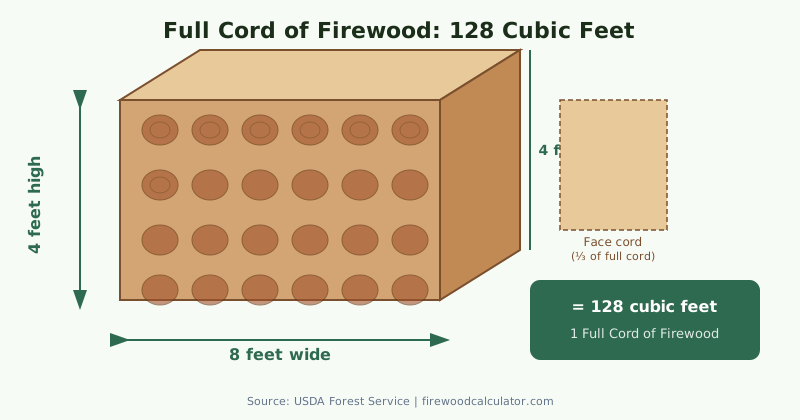
Quick Answer: Most homes with an EPA wood stove need 1.5–3 cords for a 5-month heating season. A 1,500 sq ft well-insulated home burning oak typically uses about 2 cords. Open fireplaces need 4–5× more wood for the same heat output — use the firewood calculator for your exact number.
Most homeowners buy firewood by feel — a truck shows up, they say "two cords," and hope for the best. That approach leaves you either scrambling for wood in February or watching a full cord rot in the yard come May. Getting the number right isn't complicated once you understand what goes into it.
The Short Answer by Home Size
For a rough starting point before you run your specific numbers through the firewood calculator:
- Small cabin (600–900 sq ft), 5-month season, oak, EPA stove: 1–1.5 cords
- Average home (1,200–1,500 sq ft), 5-month season, oak, EPA stove: 1.5–2.5 cords
- Larger home (2,000–2,500 sq ft), 5-month season, oak, EPA stove: 3–4 cords
- Open fireplace at any size: multiply those estimates by 3–5×
These are ballpark figures. Your actual number depends on four variables: home size, heating season length, wood species, and appliance efficiency. The difference between an open fireplace and an EPA-certified stove — burning the same wood in the same home — is massive. One converts 75% of a log's energy into heat; the other converts 15%.
What Actually Determines Your Cord Count
Home Size and Insulation
The bigger and draftier your home, the more BTU it needs to stay warm. A 1,500 sq ft home with good insulation (updated windows, blown-in attic insulation) might need 3,500 BTU per square foot per heating month. The same-sized older home with single-pane windows and minimal insulation could need 6,000 BTU/sq ft/month — nearly twice as much.
The National Insulation Association estimates that roughly 90% of American homes are under-insulated. If your house was built before 1980 and hasn't had a weatherization upgrade, assume your insulation is "average" at best when using the calculator. That means budgeting for more wood, not less.
Heating Season Length
Five months (November–March) is a typical heating season in the northern US and most of Canada. In New England, that often stretches to six or even seven months. In the Southeast, two to three months is more typical. This variable has a direct linear effect: seven months needs 40% more wood than five months, all else equal.
Don't forget shoulder months. October and April can have stretches of nights below 30°F, and you'll burn through wood faster than you expect during those transitional weeks. A common mistake is budgeting only for December through February and running short in late March.
Wood Species
Oak (24 million BTU/cord) is the gold standard for home heating in the eastern US. Hickory puts out even more at 27.7 million BTU/cord but is harder to find. Maple matches oak nearly perfectly. If you're buying birch, budget for about 15% more wood than oak to get the same heat output.
Softwoods are where people get surprised. Pine delivers only 15.9 million BTU/cord — about 34% less than oak. Cedar is even lower at 13 million. If your local supplier offers "a cord of mixed wood" for a discount, ask what species mix you're getting. A cord of 60% pine and 40% oak will perform very differently than all-oak. See our BTU chart by wood species for a full comparison.
Appliance Efficiency
This is the most underestimated variable. The efficiency ratings:
- EPA-certified wood stove (2020+): 70–80% (use 75%)
- Older non-catalytic wood stove (pre-2020): 60–70% (use 65%)
- Fireplace insert: 40–65% (use 50% as a conservative estimate)
- Open masonry fireplace: 10–20% (use 15%)
Going from an open fireplace to an EPA stove doesn't just cut your firewood bill — it can eliminate four out of every five cords you'd otherwise need. That math is why fireplace-to-insert upgrades typically pay for themselves in 2–4 heating seasons.
Worked Example: 1,800 sq ft Home, 5 Months, Oak, Older Stove
- BTU needed per month: 1,800 sq ft × 4,500 BTU/sq ft (average insulation) = 8,100,000 BTU/month
- Total BTU needed: 8,100,000 × 5 months = 40,500,000 BTU
- Effective BTU per cord of oak: 24,000,000 × 0.65 (older stove) = 15,600,000 BTU/cord
- Cords needed: 40,500,000 ÷ 15,600,000 = 2.6 cords
Add a 15% weather buffer: 2.6 × 1.15 = 3 cords. That's your order.
Run your own numbers in our firewood needs calculator — it takes about 90 seconds.
The Weather Buffer Rule
Always add 10–15% to your calculated estimate before ordering. Here's why:
- Cold snaps can push a 5-month season into 6 months
- Wood moisture content affects output — even "seasoned" wood can be wetter than expected
- You'll burn more during holidays when you want bigger fires
- Delivery delays can strand you without wood at the worst time
Ordering 10% extra costs maybe $30–50 on a typical delivery. Running out of wood mid-January and paying emergency prices — or scrambling to find a supplier with availability — costs far more in both money and stress.
Softwood vs. Hardwood: Adjusting Your Estimate
If you're heating primarily with softwood (pine, spruce, cedar), your cord needs go up significantly. A useful adjustment:
- Pine instead of oak: multiply your estimate by 1.5
- Spruce instead of oak: multiply by 1.55
- Cedar instead of oak: multiply by 1.85
That's not to say softwood is bad — pine lights easily, makes a good fire starter, and is often cheaper per cord. Many experienced wood burners keep a small softwood supply for quick-start fires and use hardwood for sustained overnight burns. Read more in our hardwood vs. softwood comparison.
Face Cords vs. Full Cords When Ordering
When you call a firewood supplier, confirm whether prices are quoted in full cords or face cords. A face cord is one-third of a full cord (roughly 42 cubic feet vs. 128). Buying "3 face cords" is only 1 full cord — a frequent source of confusion that results in people thinking they have more wood than they do.
If a supplier says "I'll deliver a cord for $250," ask them to confirm it's a full cord (4 ft deep × 4 ft high × 8 ft wide). Reputable dealers will have no problem confirming the measurement.
When to Order
The best time to order firewood is late spring through early summer — May through July. Here's why:
- Prices are lower (off-peak season)
- Wood has the summer to finish seasoning before you need it
- Suppliers have better availability and can be more selective about species
Ordering in October when everyone else is scrambling typically means higher prices, lower-quality (greener) wood, and delivery delays. If you want to use our cord estimator to plan ahead, do it in April — then order.