8 Common Firewood Mistakes That Cost You Heat and Money
Avoid the most common firewood mistakes: burning green wood, wrong species, poor storage, improper piece size, and creosote-causing habits that waste money and risk safety.
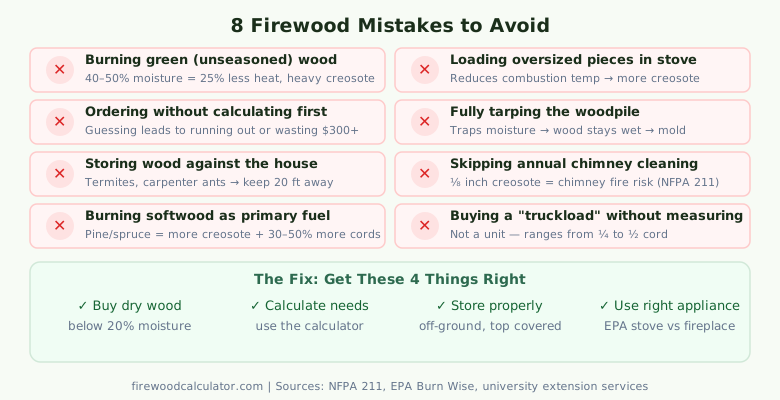
Quick Answer: The most costly firewood mistakes are burning green (wet) wood, using an open fireplace as primary heat, storing wood against your house, and buying by "truckload" without verifying cord dimensions. Always measure moisture (target under 20%), buy seasoned hardwood, and confirm 128 cubic feet stacked for every cord you pay for.
Most firewood problems aren't about bad luck — they're about preventable mistakes made at the buying, storing, or burning stage. Some of these mistakes are just inefficient (wasted money, more trips to the woodpile). Others are safety risks. Here are the eight most common ones, and exactly how to fix each.
Mistake 1: Burning Green (Unseasoned) Wood
This is the most common and most costly mistake. Green firewood can contain 40–60% moisture by weight. That water absorbs energy when the wood burns — energy that should be heating your home instead boils off as steam. The result: 15–25% less usable heat per cord, more smoke, and far more creosote deposited in your flue.
The problem is that green wood is often cheaper, easier to find, and looks fine to the untrained eye. A newly split piece of oak looks similar whether it was cut 3 weeks ago or 18 months ago — until you check with a moisture meter.
The fix: Buy seasoned wood with less than 20% moisture, or buy green wood in spring and season it yourself through summer. A pin-type moisture meter ($15–25) is the only reliable way to verify. Check our firewood seasoning guide for the full process.
Mistake 2: Ordering Without Calculating Your Needs First
Most people guess when ordering firewood. The guess is usually based on "what we did last year" — which may have been too much, too little, or with a different stove, wood type, or winter than this year.
Order too little and you'll pay emergency prices in January — when demand is highest and options are fewest. Order too much and you're tying up $300–$600 in wood sitting in your yard.
The fix: Use the firewood calculator before you order. It accounts for home size, insulation quality, wood type, heating season length, and appliance efficiency. Takes 90 seconds. Order with a 10–15% buffer, not a guess.
Mistake 3: Storing Wood Against the House
Almost every pest that lives in a woodpile — termites, carpenter ants, wood-boring beetles, mice — is looking for food or shelter. A woodpile 3 feet from your foundation is a highway directly into your home.
The Cooperative Extension Services in multiple states recommend keeping wood at least 20 feet from any structure. That seems like a lot until you've dealt with a termite infestation traced back to a woodpile.
The fix: Move the pile. 20 feet minimum. If that's not feasible, 10–15 feet plus a regular inspection of the pile base for pest activity. Bring only 2 days' worth of wood inside at a time.
Mistake 4: Burning the Wrong Wood in a Wood Stove
An open fireplace tolerates a wide range of wood quality and species because it's not optimized for anything. A wood stove is an appliance with specific operating parameters.
What not to burn in a wood stove:
- Softwood as primary fuel: Pine, spruce, and cedar produce significantly more creosote and require more frequent cleaning. Use them for kindling only.
- Wet or green wood: Produces excessive smoke, tar, and creosote buildup
- Pressure-treated or painted wood: Releases toxic arsenic compounds and heavy metals
- Driftwood: High salt content corrodes stove parts and flue
- Plywood and particleboard: Formaldehyde-based adhesives release toxic fumes
- Cardboard in volume: Acceptable occasionally for starting; heavy use overheats the stove and sends sparks up the flue
The fix: Stock the right wood for your appliance. See our best firewood for wood stoves guide for ranked species by performance.
Mistake 5: Loading Pieces That Are Too Large
Oversized firewood in a wood stove is a two-part problem. First, large pieces in a small firebox don't combust completely — they smolder, producing more smoke and creosote. Second, they cool down the overall fire temperature, which further reduces efficiency.
Most wood stoves are designed for pieces 16–18 inches long and 3–6 inches in diameter. Loading 24-inch pieces or 8-inch diameter splits might technically fit, but it degrades combustion.
The fix: Check your stove manual for maximum recommended piece size. When in doubt, split larger pieces before loading. A 5-inch diameter split burns better than a 9-inch diameter piece every time.
Mistake 6: Not Covering the Woodpile Properly
Wrapping a woodpile entirely in a tarp seems like good protection. It's actually one of the worst things you can do. A fully enclosed tarp traps moisture from rain and ground evaporation inside the pile, preventing drying and actively encouraging mold and fungal growth.
The fix: Cover the top rows only, leaving all four sides open to airflow. Use a piece of metal roofing, a cut tarp with 12-inch overhang, or a dedicated firewood cover. For long-term storage, a three-sided firewood shed with an open front is ideal. See our detailed firewood storage guide.
Mistake 7: Skipping the Annual Chimney Cleaning
Even with seasoned wood, all wood fires produce some creosote. This sticky, flammable residue builds up in the flue liner, especially in sections with lower temperatures (outside wall sections, caps). A buildup of 1/8 inch or more is a fire risk; 1/4 inch or more is a documented chimney fire waiting to happen.
The National Fire Protection Association (NFPA 211) requires annual inspection of all wood-burning appliances and recommends cleaning when deposits reach 1/8 inch. Most homeowners who burn regularly need cleaning every 1–2 years.
The fix: Schedule annual chimney inspections, and clean when deposits warrant. If you've been burning consistently for 2+ years without a cleaning, get one now. Chimney fires are violent, damaging, and dangerous — the $150–$300 cleaning fee is a trivial cost compared.
Mistake 8: Buying a "Truckload" Without Asking What That Means
"I'll bring you a load of wood" or "a truckload" is not a measurement. A full-size pickup bed holds roughly 1/3 to 1/2 cord when stacked to the rails. A compact pickup holds 1/4 cord. If someone quotes you "$150 for a truckload," you might be buying anywhere from 1/4 cord to 1/2 cord.
The fix: Always ask for a measurement in cords. "Is that a full cord of 128 cubic feet?" If the answer is vague or you can't verify, calculate what you should receive based on the stated dimensions and check it on delivery. Our cord measurement guide covers how to verify any firewood purchase.
The Bottom Line
Most firewood problems are solvable before they start. Know how much you need (use the firewood estimator), buy verified dry wood from a reputable source, store it properly, and use the right appliance. Get those four things right and you'll heat your home efficiently, safely, and without unpleasant surprises mid-January.